Conversely, if your veterinarian dismisses your concerns about your pet’s anxiety or compulsive tail-chasing as "just a quirk," seek a second opinion—ideally from a diplomate of veterinary behavior.
For decades, veterinary medicine focused primarily on the physiological: the broken bone, the infected wound, the failing organ. Behavior was often an afterthought—a "soft science" relegated to dog trainers and zoo keepers. But today, the landscape is shifting dramatically. The fusion of animal behavior and veterinary science has emerged not as a niche specialty, but as a cornerstone of modern animal healthcare.
If your animal exhibits a sudden change in behavior—aggression, withdrawal, inappropriate elimination, or vocalization—the first stop is not a trainer but a veterinarian. Once organic disease (pain, endocrine disorder, neurological lesion) is ruled out or treated, then, and only then, does the behavioral modification begin.
Understanding why an animal acts the way it does is often the first step in diagnosing how it is physically failing. This article explores the deep, symbiotic relationship between these two fields, revealing how a behavioral lens can transform diagnosis, treatment, and the human-animal bond. To separate behavior from biology is a logical error. Every action an animal performs—from a cat’s sudden aggression to a horse’s refusal to enter a stall—is rooted in neurochemistry, endocrinology, and genetics. The Neuroendocrine Connection Veterinary science has long acknowledged that hormones drive behavior. A bitch in estrus exhibits flagging and receptivity; a tomcat sprays urine to mark territory. But subtler connections are now being mapped in clinics worldwide. For example, canine cognitive dysfunction (CCD)—the veterinary equivalent of Alzheimer’s—presents not as a bloodwork anomaly, but as disorientation, altered sleep-wake cycles, and loss of housetraining. A veterinarian who ignores behavior might dismiss a senior dog’s circling as a quirk; a veterinarian trained in behavior recognizes a neuropathological emergency.
In the end, the animal cannot tell us where it hurts. It can only show us. is the language; veterinary science is the translator. Together, they speak for the voiceless. Keywords integrated: animal behavior and veterinary science, low-stress handling, veterinary behaviorist, pain-induced aggression, cooperative care, separation anxiety, equine gastric ulcers, microbiome-gut-brain axis.






No unuseful, duplicated, overridden, or longhand CSS. CSS Scan runs hundreds of real-time advanced optimizations on the code to make it shorter, crystal clear, and prettier. Exactly the way you like it.
Understand how everything works without wasting time hunting through infinite CSS rules on the browsers' Dev Tools.
Get all the active styles on the fly and finish your work faster.
Use shortcuts to work with it even quickier.
If you want to copy the CSS of this element right now, it's a pain. With CSS Scan, you just click, and it's yours. It copies all child elements, pseudo-classes and media queries. Create your perfect page.


1. Open the extension
Go to any website and click on the extension icon on your browser’s toolbar to open it.
button
.edit-btn
92.1×40.8
2. Hover over any element
Hover any element and you’ll instantly get their CSS code. Inspect, debug, and understand the styling on the fly.
Copied to clipboard!
3. Click to copy
Click to copy the code, or press the space bar to pin and edit. Copy thousands of elements with a single click.

A Card Title
dribbble.com
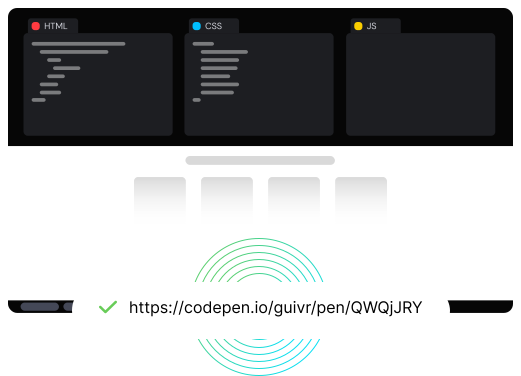
Extract the HTML and CSS of elements and all its child elements (as whole components).
You can save these Codepen snippets on the cloud and start your collection of beautiful elements that you can use on your projects from today on.
To be able to export an element, first pin the CSS window by pressing the space bar.
WordPress, Wix, Squarespace, Shopify, React, etc. CSS Scan runs on the browser as an extension so it works on any website, any theme and even works offline!
Choose your favorite: Chrome, Firefox, Safari, and Edge. Internet Explorer maybe never.


Conversely, if your veterinarian dismisses your concerns about your pet’s anxiety or compulsive tail-chasing as "just a quirk," seek a second opinion—ideally from a diplomate of veterinary behavior.
For decades, veterinary medicine focused primarily on the physiological: the broken bone, the infected wound, the failing organ. Behavior was often an afterthought—a "soft science" relegated to dog trainers and zoo keepers. But today, the landscape is shifting dramatically. The fusion of animal behavior and veterinary science has emerged not as a niche specialty, but as a cornerstone of modern animal healthcare. videos de zoofilia gays abotonados por perros
If your animal exhibits a sudden change in behavior—aggression, withdrawal, inappropriate elimination, or vocalization—the first stop is not a trainer but a veterinarian. Once organic disease (pain, endocrine disorder, neurological lesion) is ruled out or treated, then, and only then, does the behavioral modification begin. But today, the landscape is shifting dramatically
Understanding why an animal acts the way it does is often the first step in diagnosing how it is physically failing. This article explores the deep, symbiotic relationship between these two fields, revealing how a behavioral lens can transform diagnosis, treatment, and the human-animal bond. To separate behavior from biology is a logical error. Every action an animal performs—from a cat’s sudden aggression to a horse’s refusal to enter a stall—is rooted in neurochemistry, endocrinology, and genetics. The Neuroendocrine Connection Veterinary science has long acknowledged that hormones drive behavior. A bitch in estrus exhibits flagging and receptivity; a tomcat sprays urine to mark territory. But subtler connections are now being mapped in clinics worldwide. For example, canine cognitive dysfunction (CCD)—the veterinary equivalent of Alzheimer’s—presents not as a bloodwork anomaly, but as disorientation, altered sleep-wake cycles, and loss of housetraining. A veterinarian who ignores behavior might dismiss a senior dog’s circling as a quirk; a veterinarian trained in behavior recognizes a neuropathological emergency. is the language
In the end, the animal cannot tell us where it hurts. It can only show us. is the language; veterinary science is the translator. Together, they speak for the voiceless. Keywords integrated: animal behavior and veterinary science, low-stress handling, veterinary behaviorist, pain-induced aggression, cooperative care, separation anxiety, equine gastric ulcers, microbiome-gut-brain axis.
Get ready to join 20,000+ professional web developers from 116 countries using CSS Scan every day to deliver world-class websites.
on Gumroad
Watch WPTuts' in-depth review of CSS Scan (8:37)
"This was an easy buy"
"It's a very useful Chrome/FF extension for me"
"Very useful! I do not even count the time I had to inspect each element"
"After seeing the benefits of CSS Scan there's no way I could go back to Inspecting elements through dev tools. It's a game changer"
"The best developer-productivity product of 2019. Should be a browser default!"
"CSS Scan by @gvrizzo: Hover over any element and copy its entire CSS rules with a single click 😍😍😍 So useful for frontend work"
"This tool is insane. Instabuy."
"I was told "but there are free funky extensions that tell you the CSS". Yeah. There are. And they don't evolve. CSS Scan does, and that is why I don't mind paying!"



Life-time license
$120 $79
One-time payment.
Limited to 2 browsers simultaneously.
🎁 Save 34% - Independence Day of Ghana Deal - only until March 13
Translations: Chinese (Amelia and Qianfei), Korean (정석원), Swedish (@Habbe), French (@Joulse_), German (@leoffard), Indonesian (@shinatakashi and @jetroidmakes), Vietnamese (@FancaSn1), Dutch (@Aidenbuis), Spanish (@inelnuno), Arabic (@alisumait), Russian (@sanches_free), Polish (@nerdontour), Hindi (@ashishgapat), Tamil (@anirudh24seven), Italian (@melilli_marco and @StErMi), Lithuanian (@karolis_sh), Bulgarian (@byurhanbeyzat), Serbian (@aleksa.piljevic), Malay (@wfxyz), Croatian (@VladoDev), Japanese (@HiYukoIm), Persian (@Noorullah_Ah), Romanian (@AlinaCSava), Telugu (@mksrivishnu). Logo: @salatielsq.
God Bless Us
 Loading demo... Please wait