
To make DJMAX RESPECT mode work, special converter is necessary
To use DJMAX RESPECT mode, the latest firmware is necessary
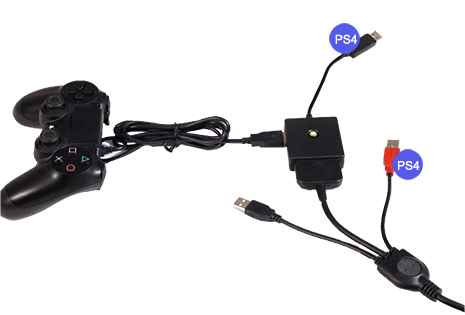
After you connect the controller according to the following steps, you can make DJMAX RESPECT mode work normally.
Converter doesn’t support PS4 PRO game body for the time being.
The blue pilot light of the converter should turn green, and keep shining after flashing about 30 seconds, then you can play game Captain Tsubasa- Road to 2002
Press start+select+5, simultaneously about a second, PS2 IIDX mode and DJMAX RESPECT mode of the controller can be switched repeatedly
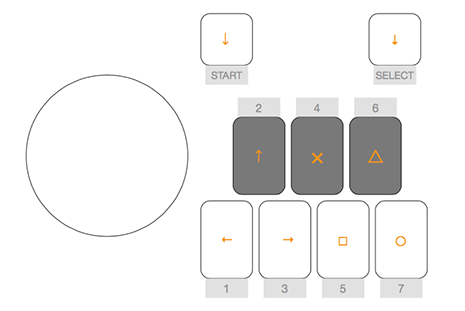
Key mapping is shown as following image
| Controller | PS4 key |
| Start | left stick ↓ |
| Select | right stick ↓ |
| 1 | ← |
| 2 | ↑ |
| 3 | → |
| 4 | × |
| 5 | □ |
| 6 | △ |
| 7 | ○ |
| Rotate turntable clockwise | left stick ↓ |
| Rotate turntable counterclockwise | left stick ↑ |
| Controller | PS4 key |
| Start+Select+4 | Option |
| Start+1 | L1 |
| Start+2 | R1 |
| Start+6 | R2 |
| Start+7 | L2 |
| Start+Select+5 | Switch for PS2 IIDX/DJMAX RESPECT game mode |
The details of the other questions are shown in “Common Question” in the bottom of this page
Captain Tsubasa: Road to 2002 remains a cherished anime series, cherished by fans worldwide for its engaging storylines, memorable characters, and thrilling soccer action. As a testament to the enduring power of the Captain Tsubasa franchise, Road to 2002 continues to inspire new fans and remind older viewers of the magic of the original series.
The original Captain Tsubasa series was a massive success, not only in Japan but also globally. Its unique blend of sports action, drama, and coming-of-age themes resonated with audiences worldwide, making it a beloved franchise across multiple generations.
One of the key strengths of Captain Tsubasa: Road to 2002 lies in its well-developed characters and exploration of mature themes. The series tackled complex issues such as pressure, stress, and the psychological aspects of competitive sports. Tsubasa, now an experienced player, had to come to terms with the weight of expectation from his teammates, coaches, and fans.
For many, the name Captain Tsubasa evokes memories of a bygone era, a time when Japanese anime was still finding its footing in the global market. However, for fans of the iconic manga and anime series, Captain Tsubasa remains an enduring symbol of passion, perseverance, and the unrelenting pursuit of excellence. One particular iteration of the series stands out among the rest: Captain Tsubasa: Road to 2002. This article will explore the impact, themes, and legacy of this beloved anime, and why it continues to captivate audiences to this day.
Before diving into the specifics of Road to 2002, it's essential to understand the context and history of the Captain Tsubasa franchise. Created by Osamu Tezuka, the original manga series was first published in 1981 and ran for 18 months. The anime adaptation, produced by Toei Animation, premiered in 1983 and consisted of 60 episodes. The series followed the journey of Tsubasa Ozora, a young and talented soccer player from Japan, as he pursued his dream of becoming a world-class athlete.
As the world of anime continues to evolve, Captain Tsubasa: Road to 2002 remains an essential part of the genre's history, a reminder of the power of sports to inspire and unite people across cultures and generations. For fans of the series, the memories and lessons learned from Road to 2002 will endure, a lasting testament to the indomitable spirit of Tsubasa Ozora and his friends.
Fast-forward to the early 2000s, and the Captain Tsubasa franchise was revived with the release of Captain Tsubasa: Road to 2002. This new iteration was produced by Studio Comet and consisted of 52 episodes, airing from 2001 to 2002. The series took place several years after the events of the original anime and followed a now-older Tsubasa Ozora as he prepared for the 2002 FIFA World Cup.
The anime also introduced new characters, including Tsubasa's rival, Rivaldo, a skilled Brazilian player who would become a thorn in Tsubasa's side. The dynamic between Tsubasa and Rivaldo added depth to the series, as they engaged in intense matches and pushed each other to new heights.